
ESG Digest (01)
October 2025






Global ESG
EU relaxes corporate sustainability directive
Source: European Parliament
Comment
There is a trend towards 'regulatory fatigue' in the European Union: The European Parliament has reached a compromise, significantly narrowing the scope of companies covered by the Due Diligence Directive (CSDDD). The threshold is now 5,000 employees and €1.5 billion in turnover, which excludes thousands of companies from regulation. In the future, there may be a wave of simplification or delays in the implementation of the ESRS and CSDDD standards.
There is a trend towards 'regulatory fatigue' in the European Union: The European Parliament has reached a compromise, significantly narrowing the scope of companies covered by the Due Diligence Directive (CSDDD). The threshold is now 5,000 employees and €1.5 billion in turnover, which excludes thousands of companies from regulation. In the future, there may be a wave of simplification or delays in the implementation of the ESRS and CSDDD standards.
ISO17298 — the first global standard on biodiversity
Source: iso.org
Comment
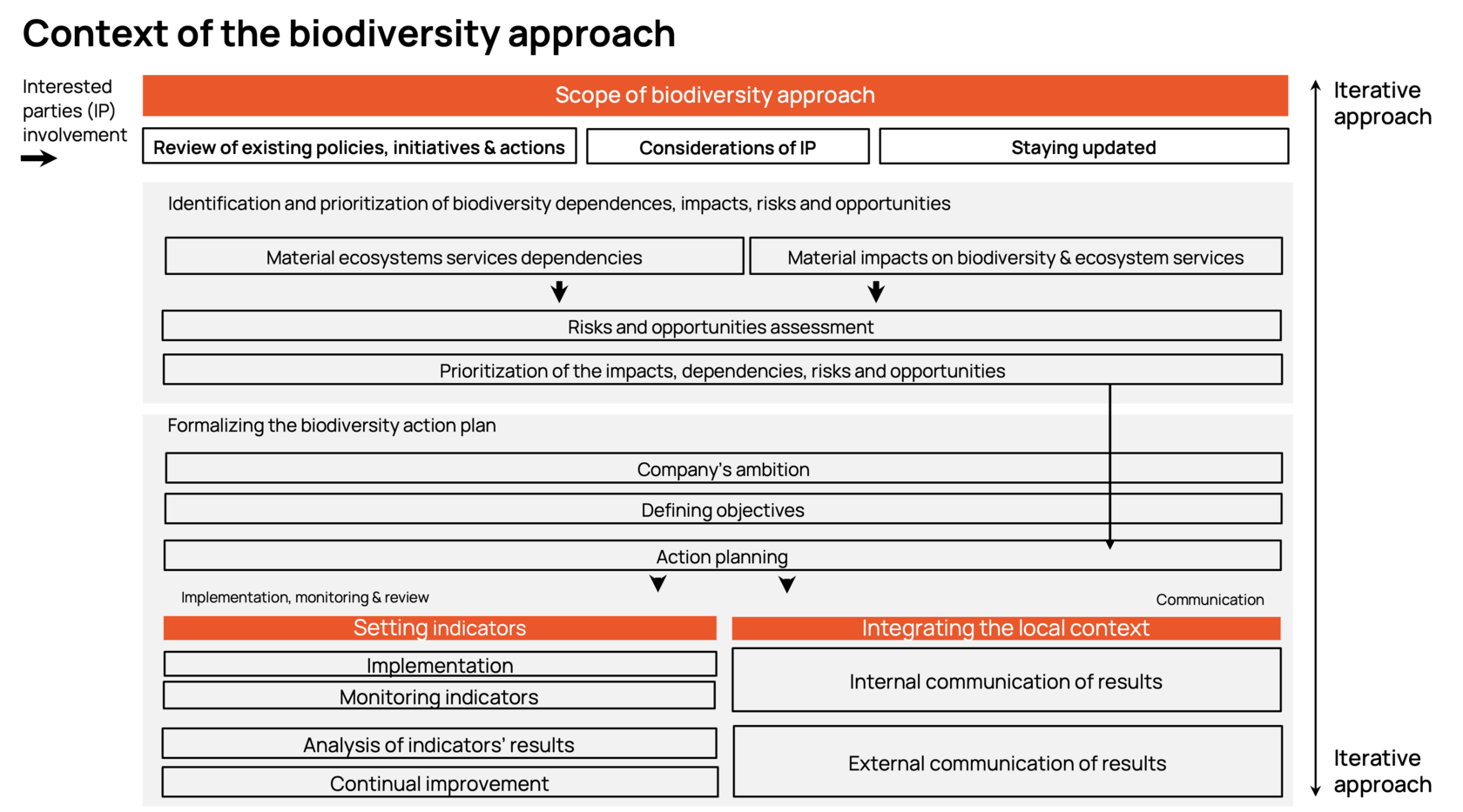
The International Organization for Standardization has introduced ISO 17298, the first global standard for managing biodiversity impact. The standard integrates natural capital into corporate governance and risk assessment. ISO 17298 is becoming a key tool for companies seeking to systematically assess and disclose natural risks in accordance with TNFD and ESRS E4.
The International Organization for Standardization has introduced ISO 17298, the first global standard for managing biodiversity impact. The standard integrates natural capital into corporate governance and risk assessment. ISO 17298 is becoming a key tool for companies seeking to systematically assess and disclose natural risks in accordance with TNFD and ESRS E4.
Contact us to get further comments on the news
The compromise between agriculture and climate remains a global problem
Source: Reuters
Comment
The New Zealand government has lowered its methane emissions reduction target from 24–47% to 14–24%. The decision has prompted accusations of 'climate denial' from scientists and environmentalists. For agricultural exporting countries, the development of methane capture technologies is a pressing issue.
The New Zealand government has lowered its methane emissions reduction target from 24–47% to 14–24%. The decision has prompted accusations of 'climate denial' from scientists and environmentalists. For agricultural exporting countries, the development of methane capture technologies is a pressing issue.
Green Energy and Technology
Renewable energy overtakes coal for the first time
Source: ember-energy.org
Comment
In 1H 2025, solar and wind generation exceeded coal's share in the global energy balance. This is a new phase in the energy transition, but regional imbalances remain significant.
In 1H 2025, solar and wind generation exceeded coal's share in the global energy balance. This is a new phase in the energy transition, but regional imbalances remain significant.
Financial Sector: Global Agenda
The SSP Global Clean Energy Transition Index outperforms both the SSP 500 and gold
Source: Bloomberg
Comment
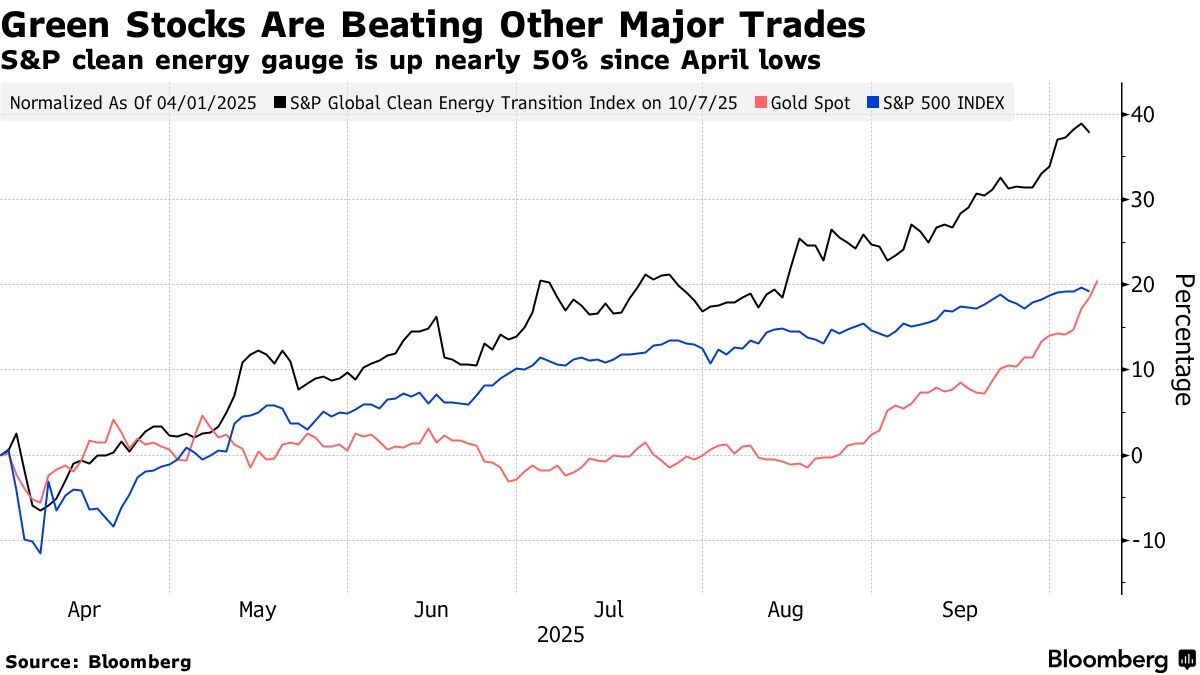
The global clean energy index is outperforming both major stock indices and gold, as investors respond to the rapidly growing demand for renewable energy sources needed to fuel the artificial intelligence (AI) boom. Investors have become more positive about green stocks, realizing that the energy required to power AI cannot be provided without renewable sources. This is happening despite attempts by the Trump administration to roll back green policies, while China, India, Europe and individual US states continue to pursue a low-carbon economy.
The global clean energy index is outperforming both major stock indices and gold, as investors respond to the rapidly growing demand for renewable energy sources needed to fuel the artificial intelligence (AI) boom. Investors have become more positive about green stocks, realizing that the energy required to power AI cannot be provided without renewable sources. This is happening despite attempts by the Trump administration to roll back green policies, while China, India, Europe and individual US states continue to pursue a low-carbon economy.
Sustainable fund assets reached a record high of USD 3 trillion
Source: Morgan&Stanley
Comment
After a decline in interest in ESG assets since 2022 amid high interest rates and geopolitical uncertainty, sustainable funds are once again showing growth and appeal to investors in 2025. At the end of June 2025, total assets under management by sustainable funds reached $3.92 trillion, which is +11.5% more than in December 2024 and +14.3% more on an annualized basis (growth is mainly driven by investment returns). This represents 6.7% of total assets. There is a shift from 'image-driven' ESG products to funds with a measurable climate impact (impact approach).
After a decline in interest in ESG assets since 2022 amid high interest rates and geopolitical uncertainty, sustainable funds are once again showing growth and appeal to investors in 2025. At the end of June 2025, total assets under management by sustainable funds reached $3.92 trillion, which is +11.5% more than in December 2024 and +14.3% more on an annualized basis (growth is mainly driven by investment returns). This represents 6.7% of total assets. There is a shift from 'image-driven' ESG products to funds with a measurable climate impact (impact approach).
ESG in Central Asia
Uzbekistan will create a registry of carbon units, 80% of which can be sold abroad
Comment
The legal framework for this will be prepared by 2026. The strategic goal is to reduce the carbon intensity of the economy by 35% by 2030 and attract investment through the export of "climate achievements". It is expected that by 2026, a list of companies that will be required to calculate their direct GHG emissions and submit reports to the relevant regulatory authority. Information on implemented GHG emission reduction projects that have undergone independent verification will enable the issuance of carbon offsets, which will be distributed as follows: 80% of the carbon offset units are planned to be sold on the international market, and the remaining 20% will be used to achieve Uzbekistan's national carbon neutrality goals.
The legal framework for this will be prepared by 2026. The strategic goal is to reduce the carbon intensity of the economy by 35% by 2030 and attract investment through the export of "climate achievements". It is expected that by 2026, a list of companies that will be required to calculate their direct GHG emissions and submit reports to the relevant regulatory authority. Information on implemented GHG emission reduction projects that have undergone independent verification will enable the issuance of carbon offsets, which will be distributed as follows: 80% of the carbon offset units are planned to be sold on the international market, and the remaining 20% will be used to achieve Uzbekistan's national carbon neutrality goals.
A draft roadmap for the implementation of Kazakhstan's strategy for achieving carbon neutrality by 2060 has been presented
Source: ATAMEKEN
Comment
The Ministry of National Economy presented a revised draft Roadmap for the implementation of Kazakhstan's Strategy for achieving carbon neutrality by 2060 at the Sustainable Development and ESG Council under the Atameken National Chamber of Entrepreneurs. Separate meetings will be held in the near future with the Ministry of Energy of the Republic of Kazakhstan on the energy sector and with the Ministry of National Economy of the Republic of Kazakhstan and the ARRFR on the financial sector. It is planned to submit the draft Roadmap to the Government by the end of October.
The Ministry of National Economy presented a revised draft Roadmap for the implementation of Kazakhstan's Strategy for achieving carbon neutrality by 2060 at the Sustainable Development and ESG Council under the Atameken National Chamber of Entrepreneurs. Separate meetings will be held in the near future with the Ministry of Energy of the Republic of Kazakhstan on the energy sector and with the Ministry of National Economy of the Republic of Kazakhstan and the ARRFR on the financial sector. It is planned to submit the draft Roadmap to the Government by the end of October.
Green Finance in Central Asia
IMF notes progress in banking sector reforms in Uzbekistan and increased transparency
Comment
As Uzbekistan transitions to a market economy, financial sector reforms are becoming a key element of economic modernization. Since 2019, the authorities have been consistently strengthening the institutional foundations of the Central Bank's independence, risk management, and transparency in the banking system. These reforms strengthen corporate governance and risk management — key elements of the 'G' (Governance) and 'S' (Social) blocks in the ESG assessment. Expanding depositor protection and introducing risk-based supervision strengthen confidence in the banking system and comply with international standards (Basel III, FATF, IMF), forming the basis for sustainable financial development.
As Uzbekistan transitions to a market economy, financial sector reforms are becoming a key element of economic modernization. Since 2019, the authorities have been consistently strengthening the institutional foundations of the Central Bank's independence, risk management, and transparency in the banking system. These reforms strengthen corporate governance and risk management — key elements of the 'G' (Governance) and 'S' (Social) blocks in the ESG assessment. Expanding depositor protection and introducing risk-based supervision strengthen confidence in the banking system and comply with international standards (Basel III, FATF, IMF), forming the basis for sustainable financial development.
Kazakhstan has tested the readiness and resilience of banks to climate risks
Comment
The Agency for Regulation and Development of the Financial Market of Kazakhstan has completed the country's first climate stress test, covering 11 major banks, which account for 85% of the sector's assets. The results showed that banks maintain adequate capital levels, but credit risks have increased in certain sectors, primarily in construction and industry. Attention should be paid to further developing methods for analyzing climate risks and improving adaptation strategies in order to increase the resilience of the financial system.
The Agency for Regulation and Development of the Financial Market of Kazakhstan has completed the country's first climate stress test, covering 11 major banks, which account for 85% of the sector's assets. The results showed that banks maintain adequate capital levels, but credit risks have increased in certain sectors, primarily in construction and industry. Attention should be paid to further developing methods for analyzing climate risks and improving adaptation strategies in order to increase the resilience of the financial system.
Digital ESG
The digital infrastructure sector is becoming a new frontier for climate adaptation
Source: Strategic Intelligence
Comment
Growing demand for artificial intelligence and electricity increases the vulnerability of digital infrastructure to heat and drought. By 2055, the cumulative climate risks to data centres could reach $3.3 trillion.
Growing demand for artificial intelligence and electricity increases the vulnerability of digital infrastructure to heat and drought. By 2055, the cumulative climate risks to data centres could reach $3.3 trillion.
GreenCo has launched a free ESG app, featuring carbon footprint calculators, ISSB readiness checklists, and a knowledge centre with educational content on ESG
Comment
Carbon footprint calculators will be relevant in various services in the future: menu planning in restaurants and cafes, calculating GHG emissions for various transport routes. The development of appropriate digital platforms for such calculations could be a useful start-up in Central Asia, in demand in various sectors of the economy.
Carbon footprint calculators will be relevant in various services in the future: menu planning in restaurants and cafes, calculating GHG emissions for various transport routes. The development of appropriate digital platforms for such calculations could be a useful start-up in Central Asia, in demand in various sectors of the economy.
Verra and SCP Global are creating a new generation platform
Comment
The new registry will combine Verra's project centre with SCP Global's environmental registry to increase transparency and efficiency. The first phase is expected to be implemented in six months, with full implementation in 2026. The collaboration aims to strengthen trust, scalability and interaction in carbon markets. Not so recently, Verra, the largest verifier of carbon credits, found itself at the centre of scandal. A project in Zimbabwe issued 15 million excess credits, affecting major corporations. Pressure on voluntary carbon markets is expected to increase, as will the risk of regulatory intervention and mandatory verification (e.g. through the ICVCM).
The new registry will combine Verra's project centre with SCP Global's environmental registry to increase transparency and efficiency. The first phase is expected to be implemented in six months, with full implementation in 2026. The collaboration aims to strengthen trust, scalability and interaction in carbon markets. Not so recently, Verra, the largest verifier of carbon credits, found itself at the centre of scandal. A project in Zimbabwe issued 15 million excess credits, affecting major corporations. Pressure on voluntary carbon markets is expected to increase, as will the risk of regulatory intervention and mandatory verification (e.g. through the ICVCM).
Google has expanded access to Carbon Footprint for Google Ads, a tool for assessing emissions in advertising campaigns
Comment
The service uses Google's own data and covers Scope 1–3 in accordance with the GHG Protocol and the Ad Net Zero initiative.
The service uses Google's own data and covers Scope 1–3 in accordance with the GHG Protocol and the Ad Net Zero initiative.
Sign up to our ESG-digests to receive regular updates on ESG news in Central Asia