
ESG digest (02)
Nov '25
Here we review in brief the key COP30 insights: from climate signals to economic trends
Global warming is accelerating: the world is heading toward +2.8 °C
Comment
According to the UN and the IEA, under current policies global warming is projected to reach 2.8 °C by 2100, while full implementation of all existing NDCs (Nationally Determined Contributions) would still limit temperature rise only to around 2.5 °C — above the Paris Agreement targets (“well below 2 °C” and efforts to limit warming to 1.5 °C). 2024 became the hottest year on record, with temperature exceedance already surpassing +1.5 °C.
Rachel Kyte, UK Climate Envoy:
“The Paris Agreement is still working — not fast enough, but without it we would already be far off track.”
The world is facing a widening “climate gap”: even if current NDCs are fully met, emissions in 2035 will remain 23 Gt CO₂-eq above a safe trajectory.
Bill Gates:
“We are falling behind the climate targets for 2040. The next decade will be decisive.”
What to expect next:
According to the UN and the IEA, under current policies global warming is projected to reach 2.8 °C by 2100, while full implementation of all existing NDCs (Nationally Determined Contributions) would still limit temperature rise only to around 2.5 °C — above the Paris Agreement targets (“well below 2 °C” and efforts to limit warming to 1.5 °C). 2024 became the hottest year on record, with temperature exceedance already surpassing +1.5 °C.
Rachel Kyte, UK Climate Envoy:
“The Paris Agreement is still working — not fast enough, but without it we would already be far off track.”
The world is facing a widening “climate gap”: even if current NDCs are fully met, emissions in 2035 will remain 23 Gt CO₂-eq above a safe trajectory.
Bill Gates:
“We are falling behind the climate targets for 2040. The next decade will be decisive.”
What to expect next:
- revision of climate scenarios (SSP2 and others)
- strengthening of NDC 2.0 with interim KPIs through 2035
- legal anchoring of national climate targets
- creation of new accountability and implementation mechanisms.
$10 trillion invested in renewables, but the transition is becoming a transition of "addition"
Comment
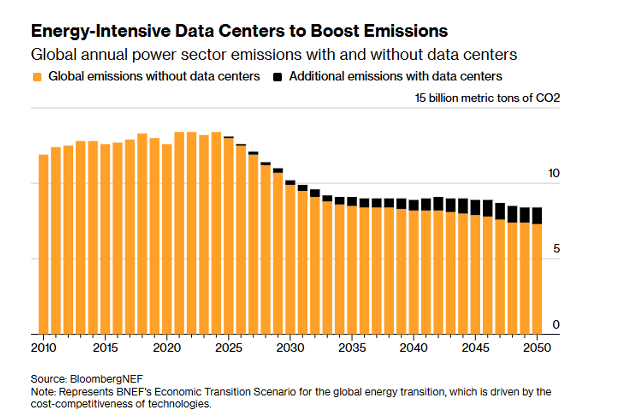
From 2014 to 2024, investments in renewables reached $10.3 trillion, including $2 trillion in 2024 alone. However, the share of fossil fuels in the global energy mix has not decreased — renewables are largely meeting new electricity demand. Key drivers are mass expansion of air conditioning and explosive growth of data centers and artificial intelligence platforms. Emissions from data centers already reach 0.1 Gt CO₂-eq and may hit 1.1 Gt CO₂-eq by 2050 — an 11-fold increase. Thus, the energy transition is becoming a transition of addition, not substitution. This requires significant investment in energy efficiency, storage, flexibility services, and green data centers.
From 2014 to 2024, investments in renewables reached $10.3 trillion, including $2 trillion in 2024 alone. However, the share of fossil fuels in the global energy mix has not decreased — renewables are largely meeting new electricity demand. Key drivers are mass expansion of air conditioning and explosive growth of data centers and artificial intelligence platforms. Emissions from data centers already reach 0.1 Gt CO₂-eq and may hit 1.1 Gt CO₂-eq by 2050 — an 11-fold increase. Thus, the energy transition is becoming a transition of addition, not substitution. This requires significant investment in energy efficiency, storage, flexibility services, and green data centers.
To stay on a 2 °C pathway, investment in clean technologies must reach $5.5 trillion/year in 2025–2030 and $7 trillion/year in 2030–2050, while actual investment in 2024 was around $2 trillion. This leaves an annual investment gap of $3.5 trillion.
New focus area — critical minerals and sustainable supply chains
Comment
For the first time, at the UN climate negotiations in Belém, countries included language on critical minerals — copper, cobalt, nickel, lithium — in the draft decision. The document proposes supply chain traceability, a legacy fund for rehabilitating abandoned mines, and scaling up recycling and circularity for transition minerals. Demand for these minerals may triple by 2030 and increase fourfold by 2040. Key concerns include China’s dominance in supply chains and environmental risks associated with mining in developing countries. Thus, a new “carbon–mineral complex” is emerging — investors are beginning to price environmental and social risks into mineral supply chains.
For the first time, at the UN climate negotiations in Belém, countries included language on critical minerals — copper, cobalt, nickel, lithium — in the draft decision. The document proposes supply chain traceability, a legacy fund for rehabilitating abandoned mines, and scaling up recycling and circularity for transition minerals. Demand for these minerals may triple by 2030 and increase fourfold by 2040. Key concerns include China’s dominance in supply chains and environmental risks associated with mining in developing countries. Thus, a new “carbon–mineral complex” is emerging — investors are beginning to price environmental and social risks into mineral supply chains.
5 regional implications for Central Asia
Comment
- NDC update: update by 2026: KZ — −35 % with sectoral KPIs, UZ — transition to absolute reduction targets.
- Energy & grids: deploy storage systems, demand-side flexibility, and green PPAs for data centers and industrial clusters.
- ETS & carbon markets: expand KazETS and prepare Article 6.2 mechanisms for international transactions.
- Critical minerals: Strengthen environmental standards and traceability for exports of copper, uranium, and rare-earth materials.
- Financing: develop a bankable project pipeline aligned with the Baku → Belém framework ($1.3 trillion/year globally).
COP30 Key Message
COP30 in Brazil marks a shift from rhetoric to implementation
The defining challenge of the next decade is not setting goals — but delivering them. For Central Asia, this represents a strategic opportunity to accelerate the renewal of national climate strategies and unlock a new level of sustainable capital inflows.
The defining challenge of the next decade is not setting goals — but delivering them. For Central Asia, this represents a strategic opportunity to accelerate the renewal of national climate strategies and unlock a new level of sustainable capital inflows.
Sign up to our ESG-digests to receive regular updates on ESG news in Central Asia