
ESG Digest (05)
June — July 2026



Global ESG
Europe Faces Growing Economic Losses from Extreme Heat
Source: Bloomberg
Europe remains the world’s fastest-warming continent, with temperatures rising at roughly twice the global average. Extreme heat is having an increasingly visible impact not only on public health but also on the economy: it reduces labor productivity, disrupts energy and transport infrastructure, increases inflationary risks and constrains potential economic growth.
According to the European Commission, EU countries need to invest around €70 billion annually in climate adaptation through 2050. Allianz analysts estimate that potential economic losses from extreme heat by 2030 could reach approximately $130 billion in Germany and $240 billion in France. In the United Kingdom, the June heatwave alone is estimated to have cost the economy £2.36 billion due to lower productivity and disruptions to infrastructure and equipment.
Economists also highlight the macroeconomic consequences. Heat and drought could add 0.4–0.9 percentage points to food inflation, while climate shocks may have lasting effects: lower returns on capital can suppress investment and productive capacity. Europe’s largest southern and western economies—Germany, France, Italy and Spain—are considered particularly vulnerable.
ESG takeaway
Climate adaptation is becoming not only an environmental priority, but also a financial and economic imperative. For companies, this reinforces the need to incorporate physical climate risks into strategic planning, asset and CAPEX assessments, and business continuity management. At the government level, the key challenge is to scale up investment in infrastructure resilience and mobilise private capital to finance adaptation measures.
According to the European Commission, EU countries need to invest around €70 billion annually in climate adaptation through 2050. Allianz analysts estimate that potential economic losses from extreme heat by 2030 could reach approximately $130 billion in Germany and $240 billion in France. In the United Kingdom, the June heatwave alone is estimated to have cost the economy £2.36 billion due to lower productivity and disruptions to infrastructure and equipment.
Economists also highlight the macroeconomic consequences. Heat and drought could add 0.4–0.9 percentage points to food inflation, while climate shocks may have lasting effects: lower returns on capital can suppress investment and productive capacity. Europe’s largest southern and western economies—Germany, France, Italy and Spain—are considered particularly vulnerable.
ESG takeaway
Climate adaptation is becoming not only an environmental priority, but also a financial and economic imperative. For companies, this reinforces the need to incorporate physical climate risks into strategic planning, asset and CAPEX assessments, and business continuity management. At the government level, the key challenge is to scale up investment in infrastructure resilience and mobilise private capital to finance adaptation measures.
China Plans to Increase Renewable Energy Consumption by 53% by 2030
Source: Bloomberg
China has unveiled a new five-year renewable energy development plan that aims to increase renewable energy consumption by approximately 53%, from 1.18 billion tonnes of coal equivalent in 2025 to 1.8 billion tonnes by 2030. One of the key priorities is to improve power-system reliability and integrate growing volumes of solar and wind generation.
By 2030, China plans to increase total electricity generation from renewable sources from 4 trillion to 6 trillion kWh. Wind and solar generation are expected to rise from 2.3 trillion to 4 trillion kWh and account for approximately 30% of total electricity generation. Together with energy-storage systems, wind and solar should supply up to 20% of electricity during evening peak-demand periods, compared with around 10% today.
The plan also provides for the development of new technologies: installed solar thermal power capacity is expected to rise from 1.82 GW to 15 GW, while marine energy capacity should grow from virtually zero to 400 MW. The non-electric use of renewable energy is also expected to expand significantly.
ESG takeaway
China’s energy transition is moving beyond simply scaling up installed renewable capacity to address the more complex challenge of ensuring power-system reliability, flexibility and controllability. Increased investment in energy storage, balancing capacity and new energy technologies could further accelerate cost reductions for these solutions globally. For international companies and investors, this also means further changes in China’s energy mix and a potential reduction in the carbon intensity of supply chains and production.
By 2030, China plans to increase total electricity generation from renewable sources from 4 trillion to 6 trillion kWh. Wind and solar generation are expected to rise from 2.3 trillion to 4 trillion kWh and account for approximately 30% of total electricity generation. Together with energy-storage systems, wind and solar should supply up to 20% of electricity during evening peak-demand periods, compared with around 10% today.
The plan also provides for the development of new technologies: installed solar thermal power capacity is expected to rise from 1.82 GW to 15 GW, while marine energy capacity should grow from virtually zero to 400 MW. The non-electric use of renewable energy is also expected to expand significantly.
ESG takeaway
China’s energy transition is moving beyond simply scaling up installed renewable capacity to address the more complex challenge of ensuring power-system reliability, flexibility and controllability. Increased investment in energy storage, balancing capacity and new energy technologies could further accelerate cost reductions for these solutions globally. For international companies and investors, this also means further changes in China’s energy mix and a potential reduction in the carbon intensity of supply chains and production.
Europe Is Warming Twice as Fast as the Global Average, Intensifying Extreme-Heat Risks
Source: The Eonomist
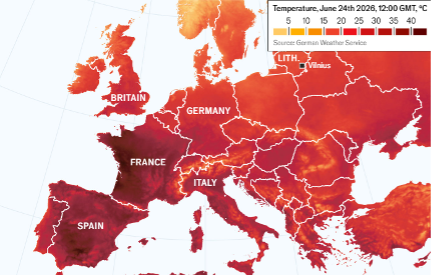
Europe is experiencing another exceptional heatwave: temperatures in France and Spain have exceeded 40°C, the highest alert levels have been declared in dozens of regions, schools have closed, trains have been canceled, and pressure on power systems has increased. According to climate scientists at ClimaMeter, anthropogenic climate change made this heatwave approximately 2–4°C hotter than it would have been under comparable weather conditions in the second half of the twentieth century.
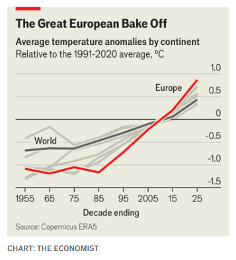
Europe is warming by approximately 0.56°C per decade—twice the global average and faster than any other continent. The factors include its high latitudes, polar amplification and lower air pollution, which allows more solar radiation to reach the surface. The central risk is not so much a possible change in the frequency of individual atmospheric patterns, but that a warmer climate makes heatwaves more frequent, intense and prolonged.
Europe is warming by approximately 0.56°C per decade—twice the global average and faster than any other continent. The factors include its high latitudes, polar amplification and lower air pollution, which allows more solar radiation to reach the surface. The central risk is not so much a possible change in the frequency of individual atmospheric patterns, but that a warmer climate makes heatwaves more frequent, intense and prolonged.
The health impacts are particularly concerning. Heat caused more than 70,000 deaths across 16 European countries in 2003, more than 60,000 in 2022 and around 50,000 in 2023. Adaptation measures are already delivering results: researchers estimate that without the measures implemented, the number of heat-related deaths in Europe in 2023 could have reached approximately 90,000.
ESG takeaway
Europe’s experience demonstrates that climate adaptation is already becoming a critical component of physical climate-risk management. Extreme heat simultaneously affects employee health and safety, labor productivity, energy supply, transport and business continuity. For companies, this strengthens the case for incorporating extreme-heat scenarios into climate risk assessments, adaptation plans and business continuity planning.
Europe’s experience demonstrates that climate adaptation is already becoming a critical component of physical climate-risk management. Extreme heat simultaneously affects employee health and safety, labor productivity, energy supply, transport and business continuity. For companies, this strengthens the case for incorporating extreme-heat scenarios into climate risk assessments, adaptation plans and business continuity planning.
Key Priorities Announced for the Upcoming COP31 Agenda
Source: UN Climate Change
COP31 will take place in Antalya on 9–20 November 2026. The formal negotiating agenda is still being developed; however, statements from the Turkish COP31 Presidency announced new targets as part of the launch of the Global Climate Action Agenda:
COP31’s main objective is to ensure the full implementation of decisions already adopted: moving beyond statements of intent and delivering tangible results. This primarily concerns the implementation of nationally determined contributions, adaptation plans and decisions made at previous climate conferences.
For Central Asian countries, one of the key issues will be the transition from broad climate goals to specific investment programs. Governments will need to translate their NDCs into sectoral roadmaps, define the required capital expenditure, implementation timelines, responsible parties and measurable performance indicators. Monitoring, reporting and verification systems that enable assessment of actual progress will become increasingly important.
Water and climate adaptation will remain particularly important for the region. Glacier melt, drought, extreme heat and the management of transboundary water resources require not only national measures but also regional coordination. In Central Asia, the announced COP31 priorities could provide additional momentum for electric transport and charging infrastructure, power-grid modernization, energy-storage systems and improved energy efficiency in buildings.
Methane reduction will also feature prominently on the agenda. For Central Asia’s oil- and gas-producing countries, this means increased attention to measures for detecting and reducing methane leaks into the atmosphere.
Kazakhstan and Uzbekistan presented their updated nationally determined contributions (NDC 3.0) in November 2025. The next step will be to demonstrate how the announced targets will be supported by government programs and corporate investment. NDC financing programs are also expected to be presented at COP31.
- the electrification target will increase electricity’s share of final energy demand from just over 20% today to 35% by 2035;
- halve the growth of global waste by 2035;
- the sustainable cities target aims to reduce energy-use intensity in the buildings sector by at least 25% by 2035;
- support the circular economy by increasing the global circular material use rate to at least 15%.
COP31’s main objective is to ensure the full implementation of decisions already adopted: moving beyond statements of intent and delivering tangible results. This primarily concerns the implementation of nationally determined contributions, adaptation plans and decisions made at previous climate conferences.
For Central Asian countries, one of the key issues will be the transition from broad climate goals to specific investment programs. Governments will need to translate their NDCs into sectoral roadmaps, define the required capital expenditure, implementation timelines, responsible parties and measurable performance indicators. Monitoring, reporting and verification systems that enable assessment of actual progress will become increasingly important.
Water and climate adaptation will remain particularly important for the region. Glacier melt, drought, extreme heat and the management of transboundary water resources require not only national measures but also regional coordination. In Central Asia, the announced COP31 priorities could provide additional momentum for electric transport and charging infrastructure, power-grid modernization, energy-storage systems and improved energy efficiency in buildings.
Methane reduction will also feature prominently on the agenda. For Central Asia’s oil- and gas-producing countries, this means increased attention to measures for detecting and reducing methane leaks into the atmosphere.
Kazakhstan and Uzbekistan presented their updated nationally determined contributions (NDC 3.0) in November 2025. The next step will be to demonstrate how the announced targets will be supported by government programs and corporate investment. NDC financing programs are also expected to be presented at COP31.
Green Finance in Central Asia
EBRD and Green Climate Fund Launch €160 Million Climate-Resilient Water Systems Program
Source: EBRD
The EBRD and the Green Climate Fund are launching the Resilient Water Systems program to modernize water infrastructure in Kyrgyzstan and Tajikistan. The financing package includes €100 million in EBRD loans, €55 million in GCF grants and €5 million in other donor co-financing. The funds are expected to support water-supply systems, wastewater treatment, irrigation, greater resilience of utility companies, and the development of long-term adaptation plans addressing drought, flooding and changes in water availability.
The program significantly expands the EBRD’s existing portfolio of water projects in the region. In Kyrgyzstan alone, by June 2026 the Bank had invested more than €196 million in 32 water-supply and wastewater projects across 28 municipalities, including €87 million in loans and €109 million in investment grants. In 2025, the EBRD and the EU also announced up to €23.8 million to modernize the Western Great Chui Canal and up to €38 million for irrigation infrastructure in the Jalal-Abad and Naryn regions. The new package therefore marks a shift from individual municipal projects towards a larger regional program integrating water supply, irrigation and climate-risk management.
The program significantly expands the EBRD’s existing portfolio of water projects in the region. In Kyrgyzstan alone, by June 2026 the Bank had invested more than €196 million in 32 water-supply and wastewater projects across 28 municipalities, including €87 million in loans and €109 million in investment grants. In 2025, the EBRD and the EU also announced up to €23.8 million to modernize the Western Great Chui Canal and up to €38 million for irrigation infrastructure in the Jalal-Abad and Naryn regions. The new package therefore marks a shift from individual municipal projects towards a larger regional program integrating water supply, irrigation and climate-risk management.
More Than $600 Million in Grants and Green Investment Commitments Announced Following the GEF Assembly in Uzbekistan
According to Uzbekistan’s National Committee on Ecology and Climate Change, agreements were reached following the Eighth Assembly of the Global Environment Facility on more than $50 million in national and regional projects financed through GEF grants. During Eco Expo Central Asia 2026, $80 million in grants and more than $520 million in green investment commitments were also announced. Around 300 agreements were signed in renewable energy, water resources and waste management. The scale of the announced agreements is significant compared with Uzbekistan’s previous cooperation with the GEF. Before the Assembly, cumulative GEF grants for environmental projects in the country totaled approximately $98.8 million, with associated co-financing of around $773.8 million. However, the more than $50 million announced in June includes both national and regional projects, so the entire amount will not necessarily be allocated directly to Uzbekistan.
The key measure of implementation will be the transition from memoranda and investment intentions to concrete projects with approved budgets, identified investors and financing timelines.
The key measure of implementation will be the transition from memoranda and investment intentions to concrete projects with approved budgets, identified investors and financing timelines.
ESG in Central Asia
EBRD Provides Up to $50 Million in Financing to KMF Bank in Kazakhstan
Source: EBRD
The financing package consists of a loan of up to $40 million for micro, small and medium-sized enterprises and a separate facility of up to $10 million under the Kazakhstan Women in Business II program. The funds may be provided in US dollars or Kazakh tenge, while the lending will be complemented by advisory services, training and mentoring support for entrepreneurs. KMF has worked with the EBRD since 2005.
The new transaction is twice the size of each of the two previous packages announced for KMF. In 2024, the bank received up to $25 million, of which $15 million was allocated to women entrepreneurs and $10 million to young entrepreneurs. In 2025, KMF received a further $25 million under the Kazakhstan Women in Business II program. The EBRD therefore announced up to $100 million in financing for KMF in 2024–2026 alone. The structure of the new package also demonstrates a broader partnership: most of the funding is now directed to the overall MSME portfolio rather than solely to specific target groups.
During the first ten years of the Women in Business program in Central Asia and Mongolia, more than 100,000 women entrepreneurs received support, with total financing of approximately $365 million.
The new transaction is twice the size of each of the two previous packages announced for KMF. In 2024, the bank received up to $25 million, of which $15 million was allocated to women entrepreneurs and $10 million to young entrepreneurs. In 2025, KMF received a further $25 million under the Kazakhstan Women in Business II program. The EBRD therefore announced up to $100 million in financing for KMF in 2024–2026 alone. The structure of the new package also demonstrates a broader partnership: most of the funding is now directed to the overall MSME portfolio rather than solely to specific target groups.
During the first ten years of the Women in Business program in Central Asia and Mongolia, more than 100,000 women entrepreneurs received support, with total financing of approximately $365 million.
Sign up to our ESG-digests to receive regular updates on ESG news in Central Asia