
ESG Digest (03)
December 2025 — January 2026



Global ESG
Key Trends in Sustainable Development 2026
Source: Webinar “Sustainability Nexus: S&P Global’s Top 10 Sustainability Trends 2026”
Comment
In 2026, sustainable development enters a phase of structural tension. The global energy transition is accelerating, but it is doing so in an increasingly fragmented manner, reflecting geopolitical fault lines and intensifying competition for capital. Investments in clean energy technologies more than tripled between 2015 and 2023; however, leadership is concentrated in a limited number of regions—most notably China, which already accounts for over 50% of global solar capacity. This concentration amplifies asymmetries in the energy transition and increases the vulnerability of global supply chains.
Against the backdrop of an accelerating energy transition, physical climate risks are becoming universal. By 2030, all sectors of the global economy are expected to be exposed to at least moderate climate impacts. Corporate preparedness for adaptation, however, remains insufficient: only 42% of companies disclose climate resilience plans. This gap is increasingly translating into operational, financial, and credit risks—particularly in capital-intensive sectors with extended supply chains.
Sustainable finance continues to expand, but it is increasingly competing with alternative investment priorities. In 2024, the global market for green bonds and loans reached USD 622 billion, while the sustainability-linked bond market amounted to USD 1.4 trillion. At the same time, investment in renewable energy declined by 6% year-on-year compared to 2023, reflecting a reallocation of capital toward digital technologies and artificial intelligence—despite the growing need for adaptation finance.
In the energy sector, 2026 represents a symbolic transition from rapid expansion to normalization. Annual additions of new solar capacity are slowing for the first time, although absolute volumes remain significant: approximately 2.8 TW of new capacity are expected to be added over the next five years—exceeding the total installed between 2010 and 2025. In parallel, the transport sector is accelerating electrification: global electric vehicle sales could reach around 40 million units per year by 2030, with China already demonstrating full price competitiveness of EVs compared to internal combustion engine vehicles.
A key source of emerging tension is the growth of AI and data centers. The rapid expansion of computing capacity is creating structural demand for electricity and may slow emissions reductions in the U.S. power sector, widening the gap between “constrained” and “unconstrained” emissions pathways by up to ~300 million tonnes of CO₂ by 2035. At the same time, around 40% of data center operators lack net-zero commitments, exacerbating the contradiction between digitalization and ESG objectives.
The expansion of AI is also intensifying another systemic constraint—water resources. By 2050, economic losses from physical climate risks are estimated at USD 1.2 trillion, of which USD 265 billion is directly linked to water stress. By 2030, approximately 43% of data centers are expected to be located in regions facing high water stress, making water a critical bottleneck for the sustainability of digital and energy infrastructure.
Against this backdrop, the degradation of natural capital remains chronically underestimated. Only 8% of companies assessed through corporate ESG evaluations have formalized commitments to biodiversity protection. This amplifies long-term risks for food systems, infrastructure, and investment resilience—particularly when combined with climate stressors.
Supply chains are increasingly becoming the nexus where climate, geopolitical, and social risks converge. All analyzed industry supply chains have at least one segment exposed to physical climate risks, with agriculture, consumer goods, and the automotive sector remaining the most vulnerable. These risks are increasingly materializing as supply disruptions and rising costs.
At the same time, the regulatory environment is moving toward gradual convergence. ISSB standards are becoming mandatory in several Latin American countries, and despite political turbulence, global ESG reporting is increasingly aligning around common principles of comparability and financial materiality.
Additional pressure stems from demographic dynamics. After 2025, the share of the global population aged 20–64 is expected to plateau at around 55%. In 2026, the intersection of global population aging and labor market dynamics emerges as a key challenge: productivity gains from AI and automation will not be sufficient to fully offset the large-scale withdrawal of workers from the labor force.
The key takeaway for 2026 is that sustainable development is no longer a standalone ESG agenda. It is becoming a matter of systemic management of resources, capital, and supply chains in an environment of increasing geopolitical fragmentation and rapid technological change.
In 2026, sustainable development enters a phase of structural tension. The global energy transition is accelerating, but it is doing so in an increasingly fragmented manner, reflecting geopolitical fault lines and intensifying competition for capital. Investments in clean energy technologies more than tripled between 2015 and 2023; however, leadership is concentrated in a limited number of regions—most notably China, which already accounts for over 50% of global solar capacity. This concentration amplifies asymmetries in the energy transition and increases the vulnerability of global supply chains.
Against the backdrop of an accelerating energy transition, physical climate risks are becoming universal. By 2030, all sectors of the global economy are expected to be exposed to at least moderate climate impacts. Corporate preparedness for adaptation, however, remains insufficient: only 42% of companies disclose climate resilience plans. This gap is increasingly translating into operational, financial, and credit risks—particularly in capital-intensive sectors with extended supply chains.
Sustainable finance continues to expand, but it is increasingly competing with alternative investment priorities. In 2024, the global market for green bonds and loans reached USD 622 billion, while the sustainability-linked bond market amounted to USD 1.4 trillion. At the same time, investment in renewable energy declined by 6% year-on-year compared to 2023, reflecting a reallocation of capital toward digital technologies and artificial intelligence—despite the growing need for adaptation finance.
In the energy sector, 2026 represents a symbolic transition from rapid expansion to normalization. Annual additions of new solar capacity are slowing for the first time, although absolute volumes remain significant: approximately 2.8 TW of new capacity are expected to be added over the next five years—exceeding the total installed between 2010 and 2025. In parallel, the transport sector is accelerating electrification: global electric vehicle sales could reach around 40 million units per year by 2030, with China already demonstrating full price competitiveness of EVs compared to internal combustion engine vehicles.
A key source of emerging tension is the growth of AI and data centers. The rapid expansion of computing capacity is creating structural demand for electricity and may slow emissions reductions in the U.S. power sector, widening the gap between “constrained” and “unconstrained” emissions pathways by up to ~300 million tonnes of CO₂ by 2035. At the same time, around 40% of data center operators lack net-zero commitments, exacerbating the contradiction between digitalization and ESG objectives.
The expansion of AI is also intensifying another systemic constraint—water resources. By 2050, economic losses from physical climate risks are estimated at USD 1.2 trillion, of which USD 265 billion is directly linked to water stress. By 2030, approximately 43% of data centers are expected to be located in regions facing high water stress, making water a critical bottleneck for the sustainability of digital and energy infrastructure.
Against this backdrop, the degradation of natural capital remains chronically underestimated. Only 8% of companies assessed through corporate ESG evaluations have formalized commitments to biodiversity protection. This amplifies long-term risks for food systems, infrastructure, and investment resilience—particularly when combined with climate stressors.
Supply chains are increasingly becoming the nexus where climate, geopolitical, and social risks converge. All analyzed industry supply chains have at least one segment exposed to physical climate risks, with agriculture, consumer goods, and the automotive sector remaining the most vulnerable. These risks are increasingly materializing as supply disruptions and rising costs.
At the same time, the regulatory environment is moving toward gradual convergence. ISSB standards are becoming mandatory in several Latin American countries, and despite political turbulence, global ESG reporting is increasingly aligning around common principles of comparability and financial materiality.
Additional pressure stems from demographic dynamics. After 2025, the share of the global population aged 20–64 is expected to plateau at around 55%. In 2026, the intersection of global population aging and labor market dynamics emerges as a key challenge: productivity gains from AI and automation will not be sufficient to fully offset the large-scale withdrawal of workers from the labor force.
The key takeaway for 2026 is that sustainable development is no longer a standalone ESG agenda. It is becoming a matter of systemic management of resources, capital, and supply chains in an environment of increasing geopolitical fragmentation and rapid technological change.
JPMorgan: The energy transition will be more volatile and prolonged
Source: Bloomberg
Comment
JPMorgan warns that the global energy transition is unfolding in a less linear manner than previously expected: volatility is increasing, and transition speeds vary significantly across subsectors. Oil and gas are expected to retain a meaningful role in the global energy mix due to growing demand, including demand driven by artificial intelligence and data centers. At the same time, the bank reaffirms its commitment to financing low-carbon solutions, highlighting key focus areas such as nuclear power, power grid modernization, and energy storage. The strategic emphasis is shifting away from a 'pure transition' narrative toward a more balanced approach that combines energy security, affordability, and decarbonization. JPMorgan is also preparing a March summit aimed at helping clean-tech companies raise equity growth capital.
JPMorgan warns that the global energy transition is unfolding in a less linear manner than previously expected: volatility is increasing, and transition speeds vary significantly across subsectors. Oil and gas are expected to retain a meaningful role in the global energy mix due to growing demand, including demand driven by artificial intelligence and data centers. At the same time, the bank reaffirms its commitment to financing low-carbon solutions, highlighting key focus areas such as nuclear power, power grid modernization, and energy storage. The strategic emphasis is shifting away from a 'pure transition' narrative toward a more balanced approach that combines energy security, affordability, and decarbonization. JPMorgan is also preparing a March summit aimed at helping clean-tech companies raise equity growth capital.
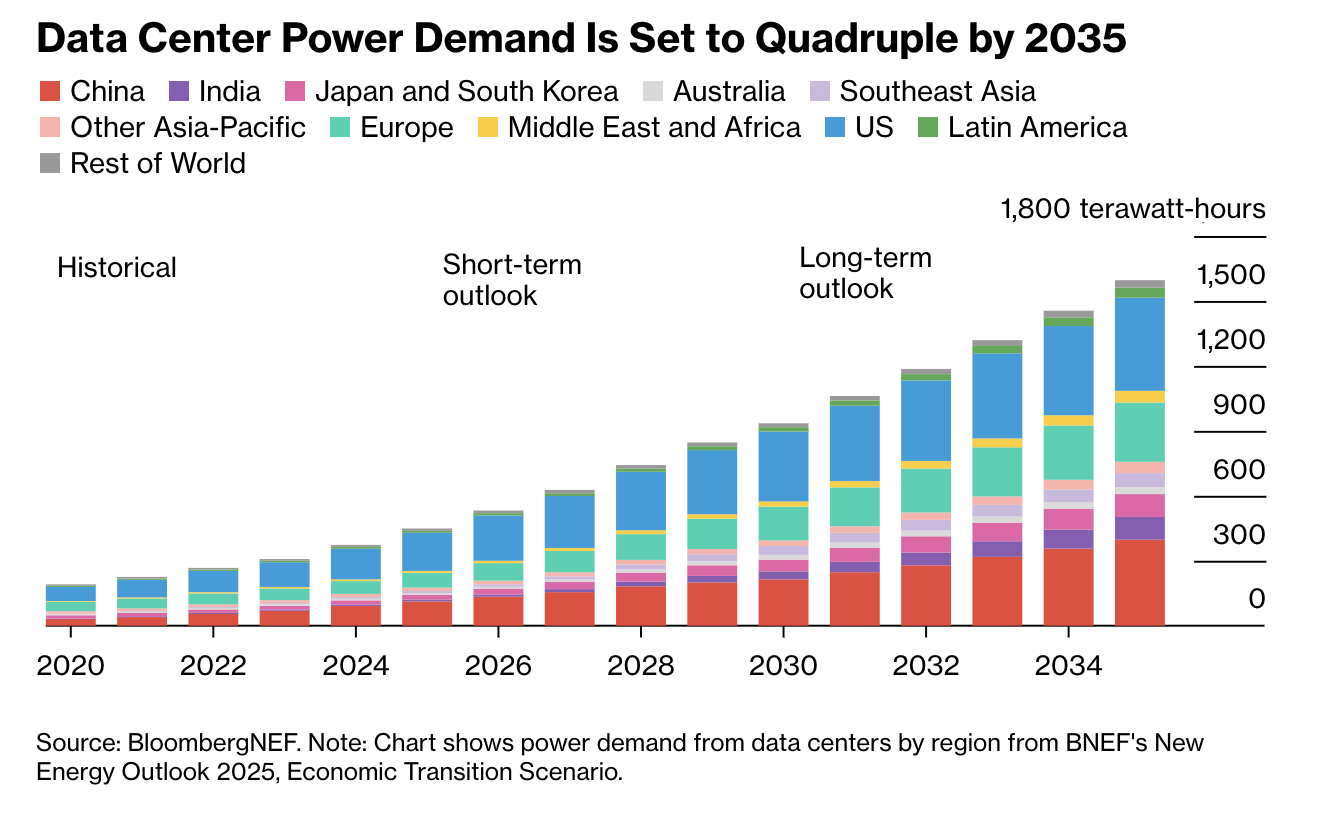
IEA: solar power to outpace all other major renewable energy sources through 2035
Source: Bloomberg
Comment
According to the International Energy Agency (IEA), renewable energy — particularly solar power — is expected to grow faster than any other major energy source through 2035. This growth is driven by rising global electricity demand, including increasing needs from AI-related infrastructure. Against this backdrop, clean energy stocks continue to outperform the broader market, while the oil and gas sector faces pressure due to oversupply and declining oil prices. Political uncertainty in the United States and Europe has not dampened investor interest in green assets.
The S&P Global Clean Energy Transition Index, tracked by exchange-traded funds with combined assets exceeding USD 5 billion, rose by more than 3% during the first trading sessions of the year. Its WilderShares counterpart gained over 8%. By comparison, the benchmark index for oil and gas producers declined by approximately 1%.
According to the International Energy Agency (IEA), renewable energy — particularly solar power — is expected to grow faster than any other major energy source through 2035. This growth is driven by rising global electricity demand, including increasing needs from AI-related infrastructure. Against this backdrop, clean energy stocks continue to outperform the broader market, while the oil and gas sector faces pressure due to oversupply and declining oil prices. Political uncertainty in the United States and Europe has not dampened investor interest in green assets.
The S&P Global Clean Energy Transition Index, tracked by exchange-traded funds with combined assets exceeding USD 5 billion, rose by more than 3% during the first trading sessions of the year. Its WilderShares counterpart gained over 8%. By comparison, the benchmark index for oil and gas producers declined by approximately 1%.
IFRS Sustainability: expanding global adoption amid persistent fragmentation
Source: Latham & Watkins
Comment
Global sustainability reporting continues to expand rapidly. As of the end of 2025, approximately 40 jurisdictions have adopted or implemented IFRS S1 and IFRS S2 within their regulatory and supervisory frameworks. Together, these jurisdictions account for around 60% of global GDP, reinforcing the role of IFRS Sustainability standards as an emerging global baseline. Since the publication of the first standards in 2022, there has been a sustained increase in the number of countries and companies aligning their ESG disclosure systems with IFRS S1/S2.
Global sustainability reporting continues to expand rapidly. As of the end of 2025, approximately 40 jurisdictions have adopted or implemented IFRS S1 and IFRS S2 within their regulatory and supervisory frameworks. Together, these jurisdictions account for around 60% of global GDP, reinforcing the role of IFRS Sustainability standards as an emerging global baseline. Since the publication of the first standards in 2022, there has been a sustained increase in the number of countries and companies aligning their ESG disclosure systems with IFRS S1/S2.
Practical implications for business
To effectively implement IFRS-based ESG standards, we advise to:
- plan implementation timelines in advance, taking into account local legislation
- consider supervisory and regulatory expectations in each jurisdiction
- manage the transition period through a hybrid approach, combining the global IFRS baseline with local ESG requirements
- integrate sustainability disclosures into risk management, internal control, and financial planning systems
ISSB eases IFRS S2 requirements on greenhouse gas emissions
Source: IFRS Foundation
Comment
The ISSB has issued targeted amendments to IFRS S2 to address practical challenges in greenhouse gas emissions disclosures. The amendments primarily affect financed emissions (Scope 3, Category 15), allow the use of alternative industry classification systems instead of GICS, and expand jurisdiction-specific relief related to calculation methodologies (GHG Protocol and IPCC GWP values). The amendments will take effect on 1 January 2027, with early adoption permitted, and are accompanied by alignment updates across selected SASB standards. The objective is to reduce the reporting burden on companies while preserving the investment relevance of disclosed information.
The ISSB has issued targeted amendments to IFRS S2 to address practical challenges in greenhouse gas emissions disclosures. The amendments primarily affect financed emissions (Scope 3, Category 15), allow the use of alternative industry classification systems instead of GICS, and expand jurisdiction-specific relief related to calculation methodologies (GHG Protocol and IPCC GWP values). The amendments will take effect on 1 January 2027, with early adoption permitted, and are accompanied by alignment updates across selected SASB standards. The objective is to reduce the reporting burden on companies while preserving the investment relevance of disclosed information.
Green Finance in Central Asia
USD 6 billion attracted through AIFC in 2025
Source: AIFC
Comment
In 2025, businesses attracted USD 6 billion in investments through the Astana International Financial Centre (AIFC) and registered more than 1,400 new companies. Since its launch in 2018, AIFC has facilitated USD 20 billion in investments into Kazakhstan’s economy. In 2025 alone, USD 6 billion was raised (USD 4 billion in portfolio investments and USD 2 billion in investments by AIFC participants), an increase of USD 2.9 billion from 2024. AIFC maintained its leadership position in the Global Financial Centres Index, ranking first among financial centres in Eastern Europe and Central Asia.
In 2025, businesses attracted USD 6 billion in investments through the Astana International Financial Centre (AIFC) and registered more than 1,400 new companies. Since its launch in 2018, AIFC has facilitated USD 20 billion in investments into Kazakhstan’s economy. In 2025 alone, USD 6 billion was raised (USD 4 billion in portfolio investments and USD 2 billion in investments by AIFC participants), an increase of USD 2.9 billion from 2024. AIFC maintained its leadership position in the Global Financial Centres Index, ranking first among financial centres in Eastern Europe and Central Asia.
Green Energy and Technology
Battery energy storage system prices continue to fall sharply
Comment
In 2025, the global average turnkey price for battery energy storage systems (BESS) reached USD 117 per kWh, according to BloombergNEF’s Energy Storage Systems Cost Survey 2025. This represents a 31% decrease compared to 2024, when the global average stood at USD 165 per kWh. Prices are now at their lowest level since the survey began in 2017, although an even sharper decline of 40% was observed between 2023 and 2024. China continues to offer the lowest turnkey system prices globally, averaging USD 73 per kWh, compared to USD 177 per kWh in Europe and USD 219 per kWh in the United States. The continued decline in energy storage costs is expected to support broader deployment of storage solutions as the share of renewables in power generation increases.
In 2025, the global average turnkey price for battery energy storage systems (BESS) reached USD 117 per kWh, according to BloombergNEF’s Energy Storage Systems Cost Survey 2025. This represents a 31% decrease compared to 2024, when the global average stood at USD 165 per kWh. Prices are now at their lowest level since the survey began in 2017, although an even sharper decline of 40% was observed between 2023 and 2024. China continues to offer the lowest turnkey system prices globally, averaging USD 73 per kWh, compared to USD 177 per kWh in Europe and USD 219 per kWh in the United States. The continued decline in energy storage costs is expected to support broader deployment of storage solutions as the share of renewables in power generation increases.
Sign up to our ESG-digests to receive regular updates on ESG news in Central Asia